 |
 |
|
954 Western Ave. Manchester, ME Home Schedule Instructors Gallery History Members > Events Calendar > Closed Dates > Curriculum > World/Sport Team Contact Us |
History of Isshinryu Karate | ||||
|
The purpose of this history page is three fold. First, to provide an understanding of the Okinawan Introduction to Martial Arts, second, to show how Master Shimabuku developed Isshinryu Karate and spread it to the United States, and finally an overview of Isshinryu today. Just as Master Shimabuku refined Isshinryu over many years, it is our duty as his students to continue to understand his message and to build upon that foundation through the training. Because of the language barrier and the lack of written records from pre-war times there are ambiguities within the information that we have available. The history of Okinawan martial arts comes to us as passed down by word-of-mouth (to the best of people's recollection). Here are compositions that we have about the history of Okinawan karate and Isshinryu in particular. Okinawan Introduction to Martial Arts 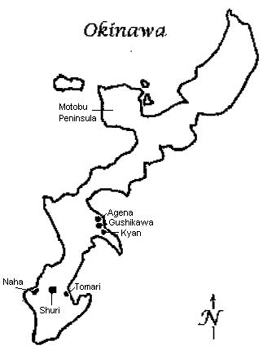 Martial arts likely first came to Okinawa
sometime during China's T'ang dynasty, 618 to 906 A.D. In Okinawa,
they called martial arts Te (hand), or Tode (T'ang hand), or
Okinawa-te (Okinawa hand), or Kara-te (China hand). In the early
1900's, an alternative meaning for karate, empty hand, became
generally accepted. Martial arts likely first came to Okinawa
sometime during China's T'ang dynasty, 618 to 906 A.D. In Okinawa,
they called martial arts Te (hand), or Tode (T'ang hand), or
Okinawa-te (Okinawa hand), or Kara-te (China hand). In the early
1900's, an alternative meaning for karate, empty hand, became
generally accepted.
Different styles of karate were named for towns, such as Naha-te, named for Naha, Okinawa's capital; or Shuri-te, named for Shuri, the home of Okinawa's ancient kings; and Tomari-te, named for the port of Tomari. Later, Naha-te developed into Goju-ryu, and Shuri-te developed into Shorin-ryu. Spreading of Martial Arts People flowed between China and Okinawa for business, education, and politics. For instance, a legendary Okinawan martial artist named Chatan Yara reportedly traveled to China (app. 1680) as an apprentice in business. He returned twenty years later with an increased knowledge of martial arts, which he passed on to Peichin Takahara. A Chinese official named Kushanku (or Kusanku) served in Okinawa for several years (arriving app. 1761). He taught his knowledge of martial arts to the legendary Okinawan master, "Karate" Sakugawa, who was also one of Takahara's students. A shipwrecked Chinese sailor named Chinto washed ashore in Okinawa in the 1800's. He hid in caves and stole food to survive. Authorities sent Sokon "Bushi" Matsumora, a student of Sakugawa, to kill the thief. He and Chinto fought for a considerable time, neither able to win. Matsumora cleverly reported the thief gone, and struck a deal with Chinto, martial arts training for food. Banning of Martial Arts For a time, karate itself was banned. But the Okinawans continued to practice in secret, at night and in caves, disguising their training forms, kata, as folk dances. The ban on karate was lifted in 1900. Shortly thereafter, Yasutsune Itosu, a student of Matusumora, began teaching it in the high schools. In 1922, Gichin Funakoshi, a student of Itosu and Yasutsune Asato, demonstrated karate for the crown prince of Japan, and soon thereafter opened the first karate dojo in Japan. For this reason, the Japanese call Funakoshi "the father of karate." Chotoku Kyan, another of Itosu's students,led the Shobayashiryu branch of Shorin-ryu. Yet another of Itosu's students, Choki Motobu, became a famous master in the Kobyashiryu branch of Shorin-ryu. Chojun Miyagi, a student of the Naha-te master, Kanryo Higaonna, founded Goju-ryu, which now branches in Japan and America as well as Okinawa. Introduction to the United States In 1945, the last battle of World War II took place on Okinawa. Afterwards, American servicemen stationed there studied karate as a means of improving their hand-to-hand combat skills. A navy man, Robert Trias, who was middleweight boxing champion of the Pacific Fleet, came back and opened the first known karate dojo in America, in 1946, in Phoenix, Arizona. After the Korean War, many American servicemen, especially Marines, studied karate with master Tatsuo Shimabuku, one of which was Don Nagle. In the 1950's, Don Nagle brought Isshinryu to America for the first time, followed shortly by Harold Long, Steve Armstrong, and Harold Mitchum, and others. The first Isshinryu dojo in Michigan opened in 1964 by Ken Pittaway, one of Don Nagle's students. Master Tatsuo Shimabuku History Early Life 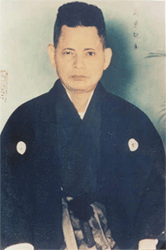 Tatsuo Shimabuku, founder of Isshin-ryu karate, was born
in Okinawa on September 19, 1908. Tatsuo, meaning Dragon man, was a
nickname given to him for his prowess in the martial arts. It is
believed that he began martial arts training around the age of 12 or
13. Tatsuo first studied under Master Kyan and soon became one of
his top students. Tatsuo Shimabuku, founder of Isshin-ryu karate, was born
in Okinawa on September 19, 1908. Tatsuo, meaning Dragon man, was a
nickname given to him for his prowess in the martial arts. It is
believed that he began martial arts training around the age of 12 or
13. Tatsuo first studied under Master Kyan and soon became one of
his top students.
Tatsuo also studied Gojo-ryu under its founder Chojun Miyagi. He also studied under the notorious fighting master Choki Motobu, who taught the Kobayashiryu version of Shorin-ryu. Tatsuo regarded Kyan, Miyagi, and Motobu as his most influential teachers, and kept portraits of them in his own dojo in a place of honor. He learned Okinawan weapons, Kobudo, from Taira Shinkin and Yabiku Moden. In later years, Shimabuku visited China to collect even more knowledge of the martial arts. He also experimented; having his students wear full contact armor, to prove which techniques worked the best. Founding of Isshinryu After more than 30 years of study and experimentation, he formulated his own system of karate. He took the best principles and techniques from the styles he studied, two empty hand katas from Gojo-ryu ( Sanchin & Seiuchin), five from Shorin-ryu (Seisan, NaiHanchi, Wansu, Chinto and Kusanku), one composed by Shimabuku himself (Sunsu), and five weapons katas (3 bo-staff- ergo: Tokomine no kun no dai, Urashi-bo & Bo shishi no kun) & (2 sai-ergo: Kusanku sai & Chatan Yaya no sai) plus a number of inovations based on his own observations, such as the vertical fist, and the snap punch!! He also practiced Kyan no sai, and Tuifa katas. The official birthday for Isshinryu is January 15, 1954. The name Isshinryu, meaning "One Heart Style" came from Eiko Kaneshi, one of Shimabuku's best Okinawan students. Shimabuku believed the principles of Isshinryu were not just for fighting, but for all of life. Grand master Shimabuku was able to witnesses the spreading of Isshinryu Karate all along the east coast of the United States before he died on May 30,1975. Isshinryu Karate Today The training and the techniques have their own evolution over
time. The original intent was self- protection in a combat
situation, but the techniques had to have their true nature hidden
due to political an societal influences over the centuries.
|
|||||
|
Associated with the Isshin-ryu School of Karate; host of the 2007 IWKA Champion- ship Tournament.  |
 |
| Home|Schedule|Instructors|Gallery|History|Members|Contact Us | |
| ©2005 pushardskarate.com - All Rights Reserved 2006 |